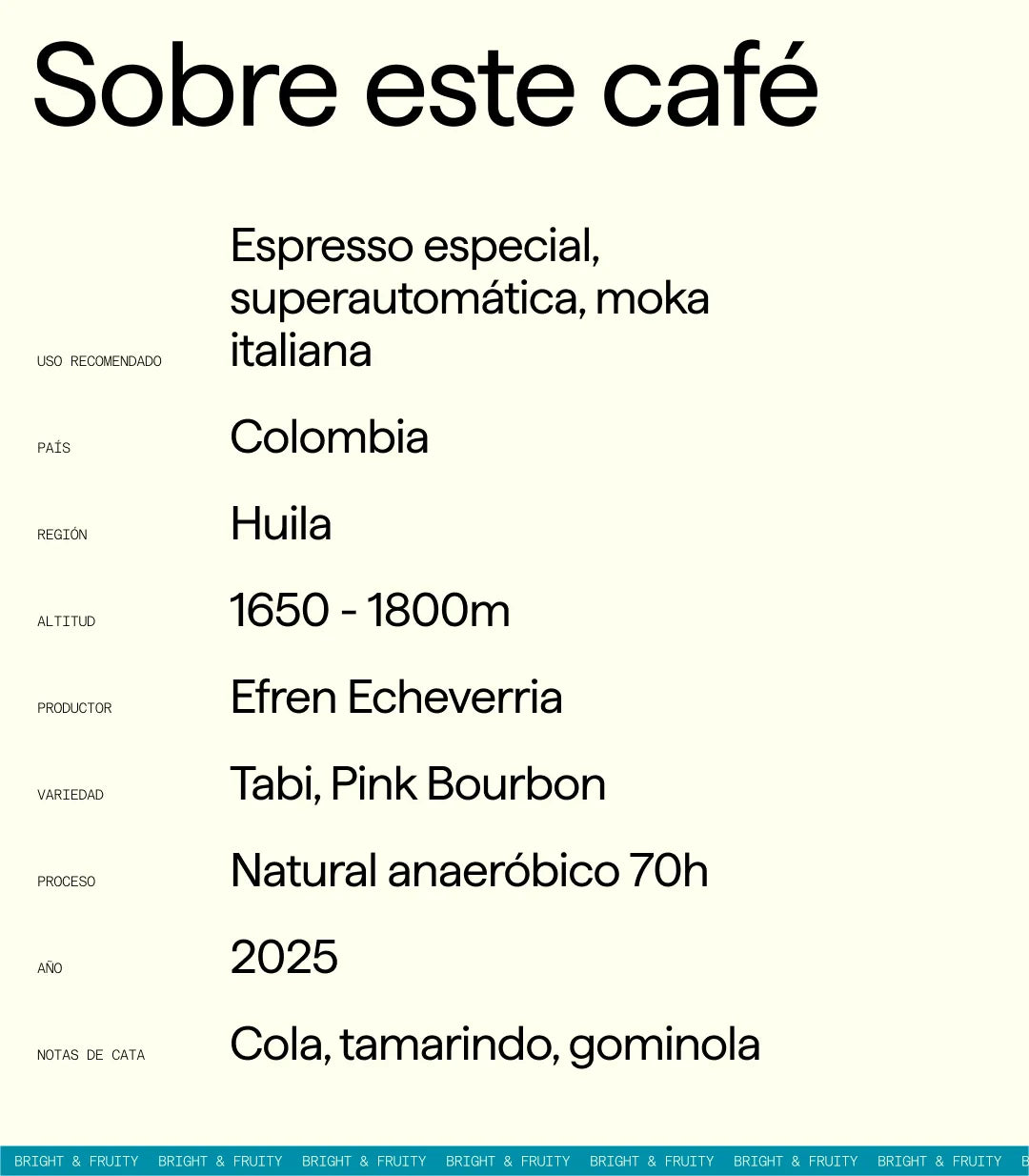
Learn more about this coffee.
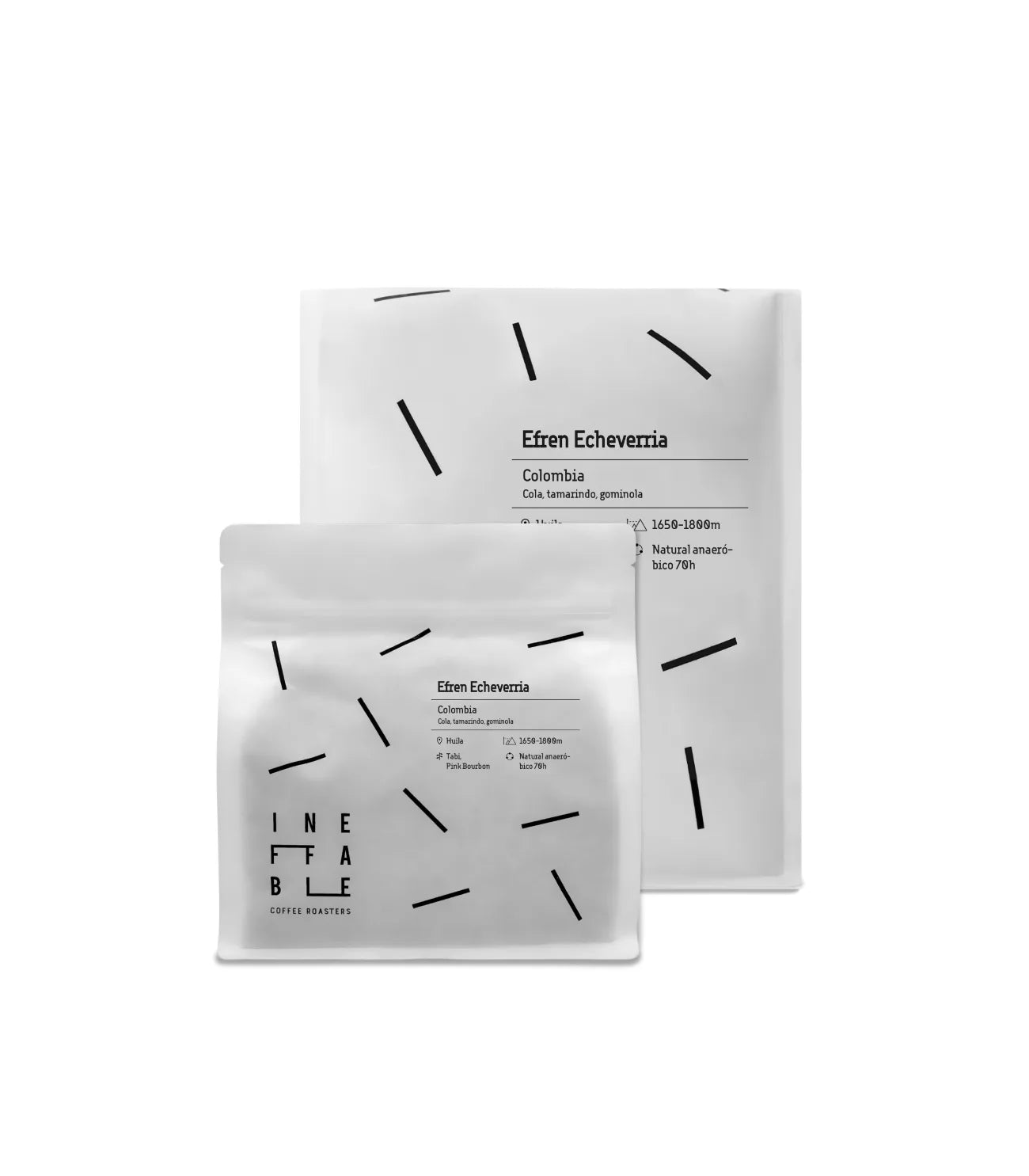
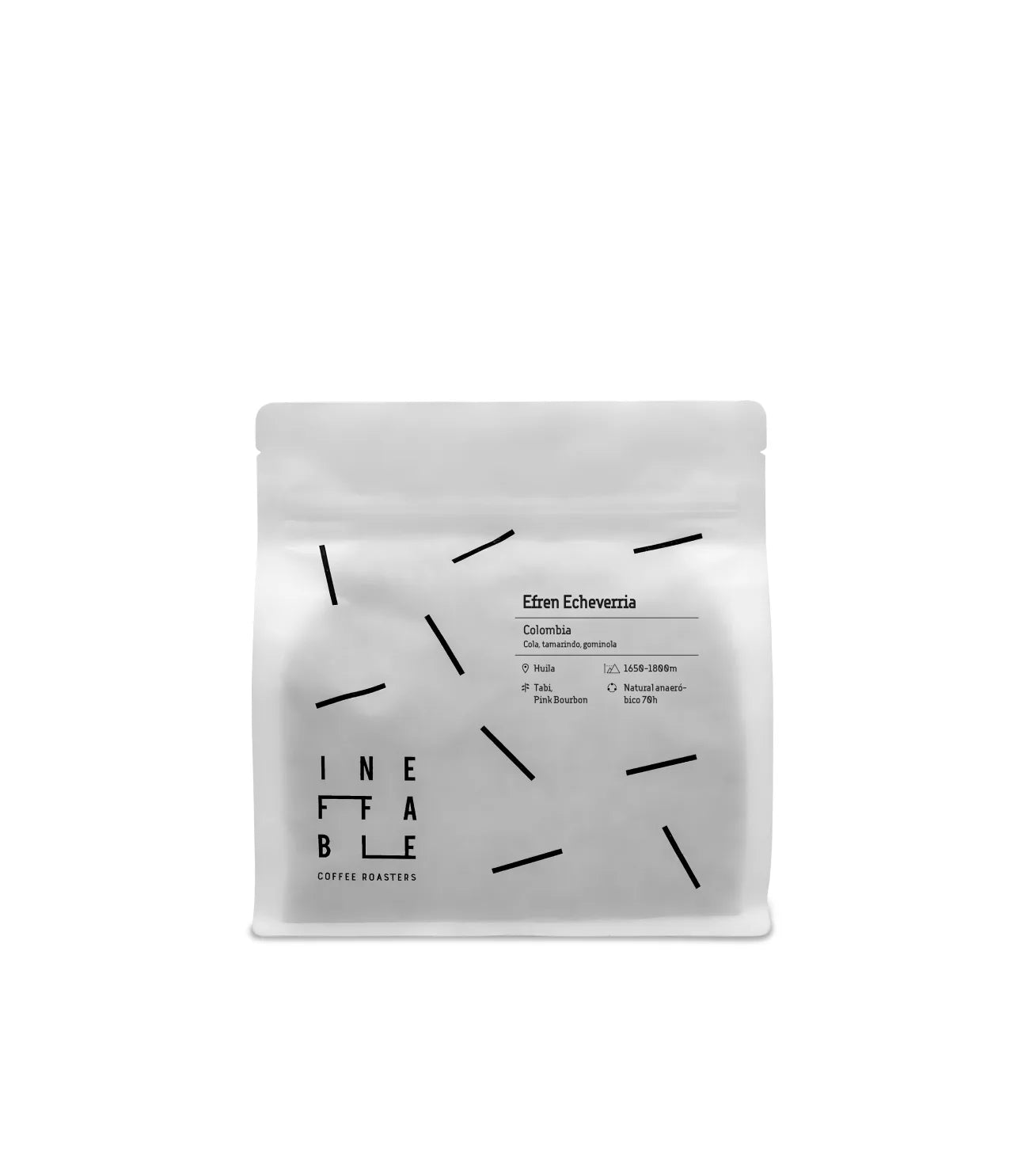
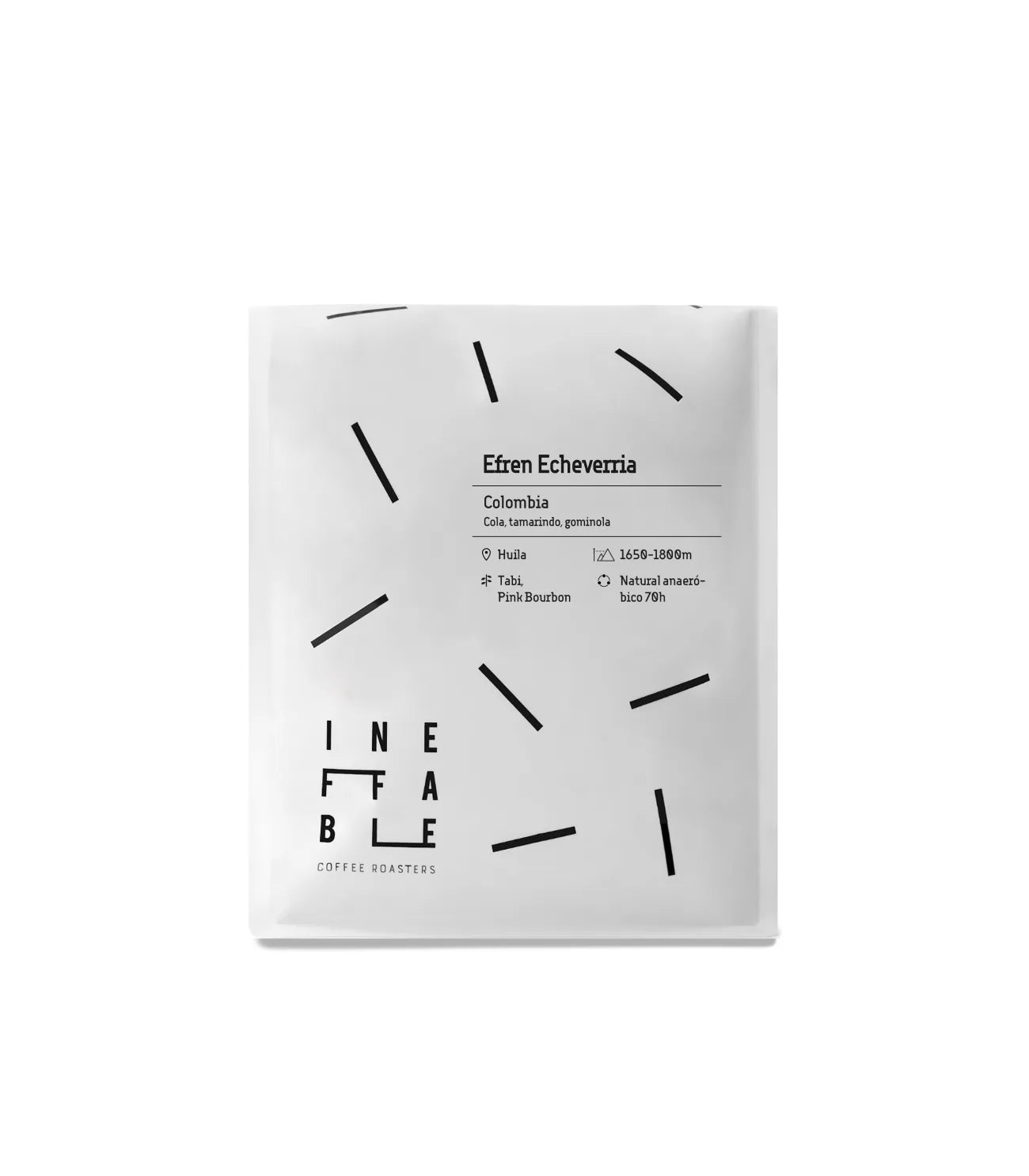
Efrén Echeverría is a producer from Huila who, together with his family, made the move into speciality coffee in 2019 after more than two decades cultivating their farm.
Located between 1,650 and 1,800 metres above sea level, the farm brings together traditional and more exotic varieties such as Tabi and Pink Bourbon, embracing innovative processing methods to express their full potential.
This lot, made up of 60% Tabi and 40% Pink Bourbon, is produced using a natural process with 70 hours of anaerobic fermentation.
The cherries, carefully hand-selected, ferment in sealed barrels before being slowly dried for 20 days under covered patios.
The result is an intense and expressive coffee, with notes of cola, tamarind and jelly sweets, reflecting the curiosity, continuous learning and ambition of a family determined to leave their mark on speciality coffee.
Meet the producer
Efren Echeverria: Innovation from Huila
In the mountains of southern Colombia, in the region of Huila, a coffee is born that speaks of evolution, curiosity and courage. Efrén Echeverría’s lot is the result of more than two decades of work on the farm — and of one pivotal decision: to embrace speciality coffee as a path towards differentiation and excellence.
In 2019, Efrén and his family made that leap. Until then, like many Colombian producers, they had cultivated coffee for years under more traditional models. But something shifted. A desire to learn, improve and explore new possibilities led them to rethink their approach. They realised that the true potential of their farm — located between 1,650 and 1,800 metres above sea level — was still waiting to be unlocked.
Altitude, varieties and a vision for the future
Altitude is one of the defining factors in coffee quality. The higher the elevation, the cooler the temperatures and the slower the cherries ripen. This slower maturation produces denser beans and more complex cup profiles. On Efrén’s farm, this privileged altitude range allows for coffees with remarkable aromatic intensity and structure.
Yet altitude alone is not enough. The Echeverría family chose to combine traditional and more exotic varieties in pursuit of greater expression. This particular lot is made up of 60% Tabi and 40% Pink Bourbon.
Tabi, a Colombian-developed variety, is known for its resilience and its clean, structured profile. Pink Bourbon, meanwhile, has become one of the country’s most sought-after varieties thanks to its aromatic complexity and vibrant acidity. Together, they create a coffee that is both balanced and lively — structured, yet full of character.

A process that makes a difference
If there is one element that truly defines this coffee, it is the process. This is a natural coffee with 70 hours of anaerobic fermentation.
After careful hand-selection of cherries at peak ripeness, the coffee is placed in sealed barrels where it ferments in the absence of oxygen. This controlled environment intensifies microbial activity and enhances the bean’s aromatic development. Over the course of 70 hours, flavour precursors are formed that later translate into a deep and expressive cup.
Following fermentation, the cherries are dried slowly for 20 days under covered patios. This gradual drying stage is essential for stabilising the beans and preserving the complexity developed during fermentation.

An intense and expressive cup
In the cup, the result is bold and memorable. Expect notes of cola and cocoa providing depth, a tamarind base that gives structure, and a jelly sweet undertone adding a juicy sweetness. The acidity, wine-like in character, brings vibrancy without disrupting balance, while the body is creamy and enveloping.
It is a coffee that leaves a lasting impression — expressive and intense, yet carefully constructed and harmonious.
More than a coffee, a declaration of intent
This lot is not only about an attractive sensory profile. It represents the moment a family chose to evolve, invest in learning and take risks to elevate their coffee to a new level. It reflects an open-minded approach to continuous improvement and the ambition to leave a mark within the world of speciality coffee.
Every cup tells that story. And ultimately, that is what makes this coffee truly special.
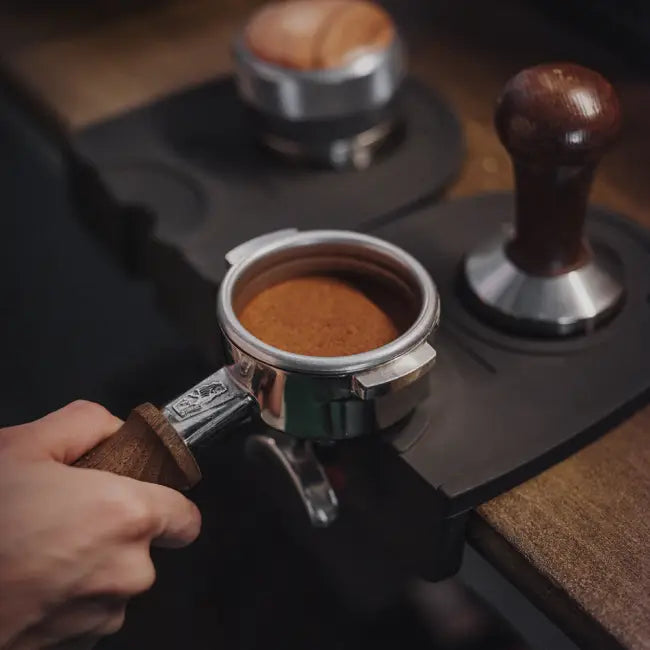
Espresso for Efren Echavarria
Here is the most updated recipe we have. It is important to remember that this recipe is for reference and that there are many variables that will influence the final result of the espresso in your cup: from the condition of your machine and grinder, the water you use, the preservation/resting of your coffee, to atmospheric temperature/pressure, etc., and therefore, you may need to modify some parameters to find a tasty and balanced espresso with your specific variables.
For example, here we use 6 bars of pressure in our machine; if yours is set to 9 bars, we would recommend reducing the extraction time by about 5 to 10 seconds to compensate.
Recipe:
- Ratio: 1:2.1
- Dry: 19gr
- In cup: 41-40gr
- Time: 29-31s
Variables:
- Resting time: minimum 2 weeks
- Temperature: 94ºC
- Pressure: 6 bars
- Pre-infusion: No
- Water: GH 60 (ppm as CaCO3) KH 30 (ppm as CaCO3)
Machinery and equipment used for this recipe:
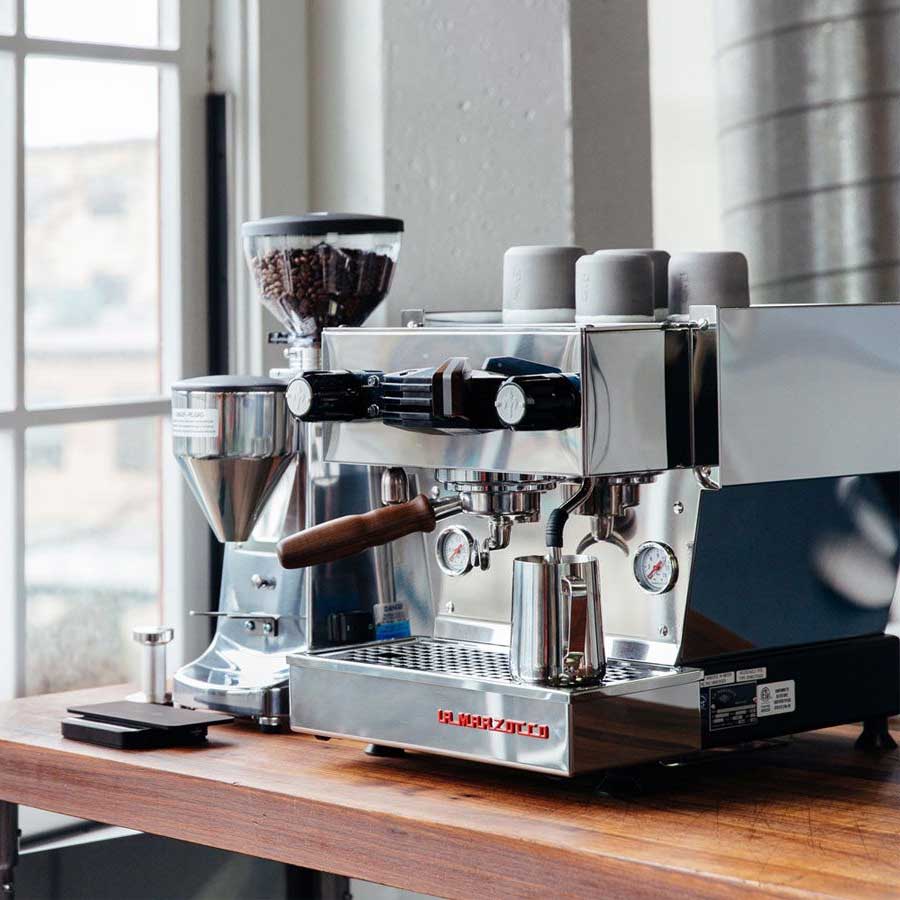
- Espresso machine: La Marzocco KB90 2G
- Grinder: Mythos 2
- Basket: 22gr VST (no ridge)
- Extras: Barista Hustle WDT, Push Tamper (flat, 100% level)
Filter for Efrén Echaverria
The following recipe is a guide designed for brewing coffee at home. Results may vary depending on your equipment, setup, and all the variables that influence extraction.
With each coffee we roast, our team conducts tests until we find a recipe that highlights all of the coffee’s qualities. The one you’ll see below includes all the necessary information to reproduce it. Even so, we always recommend trying and experimenting to discover what you like best: use it as a guideline and adapt it to your own style.
Remember: it's the journey that matters, not the destination.
Keep in mind: Water is the most important factor in achieving a great cup of coffee. Depending on where you live, its composition can vary drastically. That’s why we recommend using at least filtered water; another option is a mix of Bezoya and Lanjarón. When adjusting the recipe, change only one variable at a time so you can identify how it affects the flavor.
It’s common to start by adjusting the coffee-to-water ratio. Once you achieve a cup with a pleasant intensity and mouthfeel, you can modify other aspects of the extraction.
Most pour-over coffee recipes use a ratio between 1:15 and 1:17, with a brew time between 2:30 and 4:30 minutes.
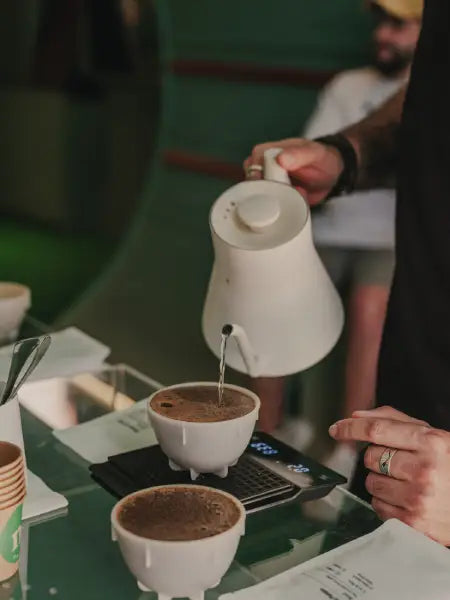
Kalita / Origami / Orea
We’ve chosen this method to share our recipes because it is very versatile and easy to adapt to other percolation systems. The flat bottom and the wave-shaped filters of Kalita create a wide surface that prevents significant flow blockages caused by the migration of fine particles or clogging.
Orea Recipe:
Ratio: 1:16.5
Coffee: 20.6 g
Water: 339 g
Total time: 4:35 min
Temperature: 98°C
Grinder: 9.5 EK43 (coarser than for other drippers)
TDS: 1.49%
EY: 21.61%
Variables:
- Rest time: It can start being consumed 3 days after the roast date, but it expresses itself best after 10–15 days (as long as the bag hasn’t been opened before; in that case, it will peak sooner).
- Water: Bezoya
- Filter: Sibarist B3
Equipment:
Orea, Sibarist B3 filter, scale, timer, grinder, cup/server, and kettle (gooseneck).
Method:
- Place the Orea on a cup/server and insert the filter. Pour hot water to rinse the filter, removing any paper taste and preheating the equipment.
- Grind the coffee at the recommended setting.
- Discard the water and place the Orea with the empty server on the scale. Add the coffee, distributing it evenly, tare the scale, and start the timer.
- Pour 60 g of water in circular movements and wait 30–40 seconds for the coffee to degas. If the coffee has been roasted recently, let it sit longer.
- Slowly pour until approximately 200–250 g of water, then gently swirl the Orea once in circular motions to level the coffee bed and ensure it is fully saturated. Never fill it to the brim—leave at least a 2 cm gap from the top to limit water bypass, thus reducing extraction.
- Continue pouring water slowly as before until you reach the total amount.
- Swirl one last time and let the water draw down.
- We are aiming for the total time indicated in the recipe, so if needed, adjust the grind size next time to reach it.
Cold brew
That's the recipe we suggest for making 600ml of cold brew. If you want to make more or less amount, the ratio is 1:15, 1g of coffee for 15g/ml of water.
Recipe and equipment:
- 40g coffee (Use your preferred coffee depending on your taste. We suggest choosing coffee profiles you like in filter brewing). If it has the "Cold Brew" tag, it's one of our favorites.
- Grinding: Comandante 16 clicks.
- Water 600g/ml at room temperature.
- Water composition: 2 parts Lanjarón and 1 part Bezoya.
- A mesh or silk.
- A glass container (preferably with a lid)
- Let it rest for 22 hours (in the refrigerator).
How to make cold brew:
- We grind the coffee to a medium ground size (Comandante 16 clicks).
- We pour the coffee directly into the mesh.
- We put the mesh into the glass container.
- We pour the water into the container through the mesh with the coffee.
- Stir gently to flood all the coffee.
- We close or cover the container.
- We leave it rest in the refrigerator (beware of strong smells!).
- After the resting time, remove the mesh with the coffee and it will be ready.
- As an extra step, you can filter it again through a V60, Kalita or similar paper filter for a cleaner and clearer result.
- Keep it refrigerated.
- This recipe is meant to be undiluted, not even with ice. Adding ice will affect the flavor of your drink, as the water composition will alter the flavor. It's best to make your own ice using the same water composition we suggest. If you do use ice, you might want to lower the ratio (1:9 to 1:12).