Skip to content

Free Cold Brew ebook with your order

Free shipping on orders over €40 for Spain (Peninsula), Balearic Islands and Portugal. Shipped within 24/48h Mon-Fri

Free shipping to Europe on orders over €99

Cart

Your cart is empty

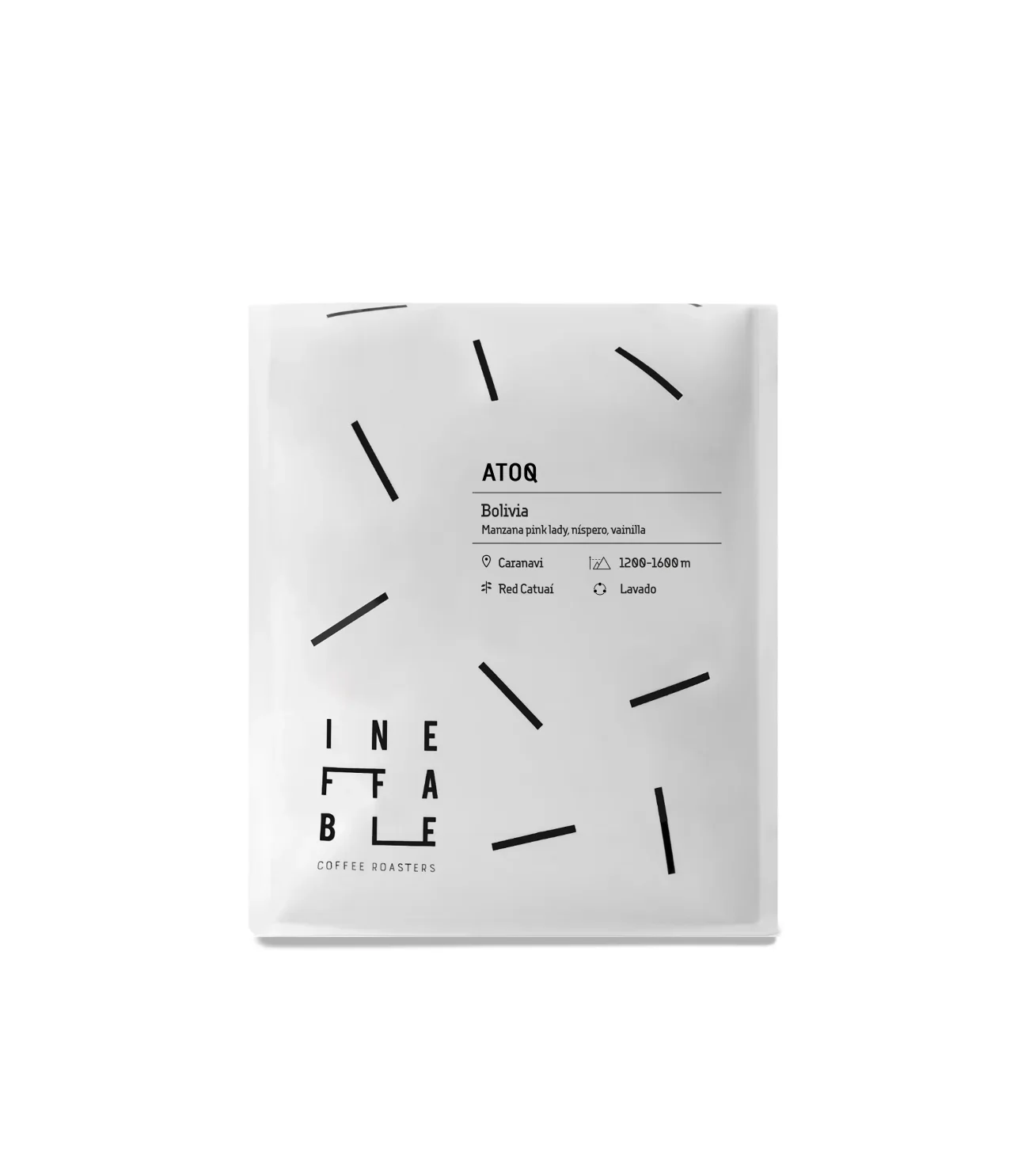
ATOQ

Sale price22,00€

Connecting with coffee producers in Bolivia is often challenging for international roasters, as much of the country’s coffee sector remains relatively unknown. Juan Boyan has become a key figure in helping change this.

This washed coffee stands out in the cup with juicy notes of Pink Lady apple and loquat. A base of vanilla and white chocolate, with a background of stone fruit. Medium, fruity finish with honeyed acidity and a silky body.

Format:

Format:

Whole bean-Ground:

Whole bean-Ground:

Whole bean-Ground:

Cantidad

ATOQ
ATOQ Sale price22,00€

Reviews of our product

Fresh seasonal coffee

Freshly roasted in Seville

Eco-Friendly Packaging

Fair price

Caution to producers

Traceability from farm to cup

Learn more about the product

Learn about this coffee in detail

Connecting with coffee producers in Bolivia is often challenging for international roasters, as much of the country’s coffee sector remains relatively unknown. Juan Boyan has become a key figure in helping change this. 

After more than two decades working alongside Pedro Rodríguez at Agricafe, he decided to become independent and build his own dry mill in La Paz, where he now works with smallholders from regions such as Caranavi. 

Juan’s ambition is to bring greater visibility to Bolivia’s lesser-known coffees, helping producers process and prepare their lots for the international market. 

Thanks to his extensive experience in quality control and microlot management, he is able to evaluate and refine each coffee that arrives at his mill. 

This lot, ATOQ, is a washed Red Catuai offering a clean and elegant cup, with notes of Pink Lady apple, loquat and vanilla.

Meet the producer

ATOQ: a gateway to Bolivia’s smallholder producers

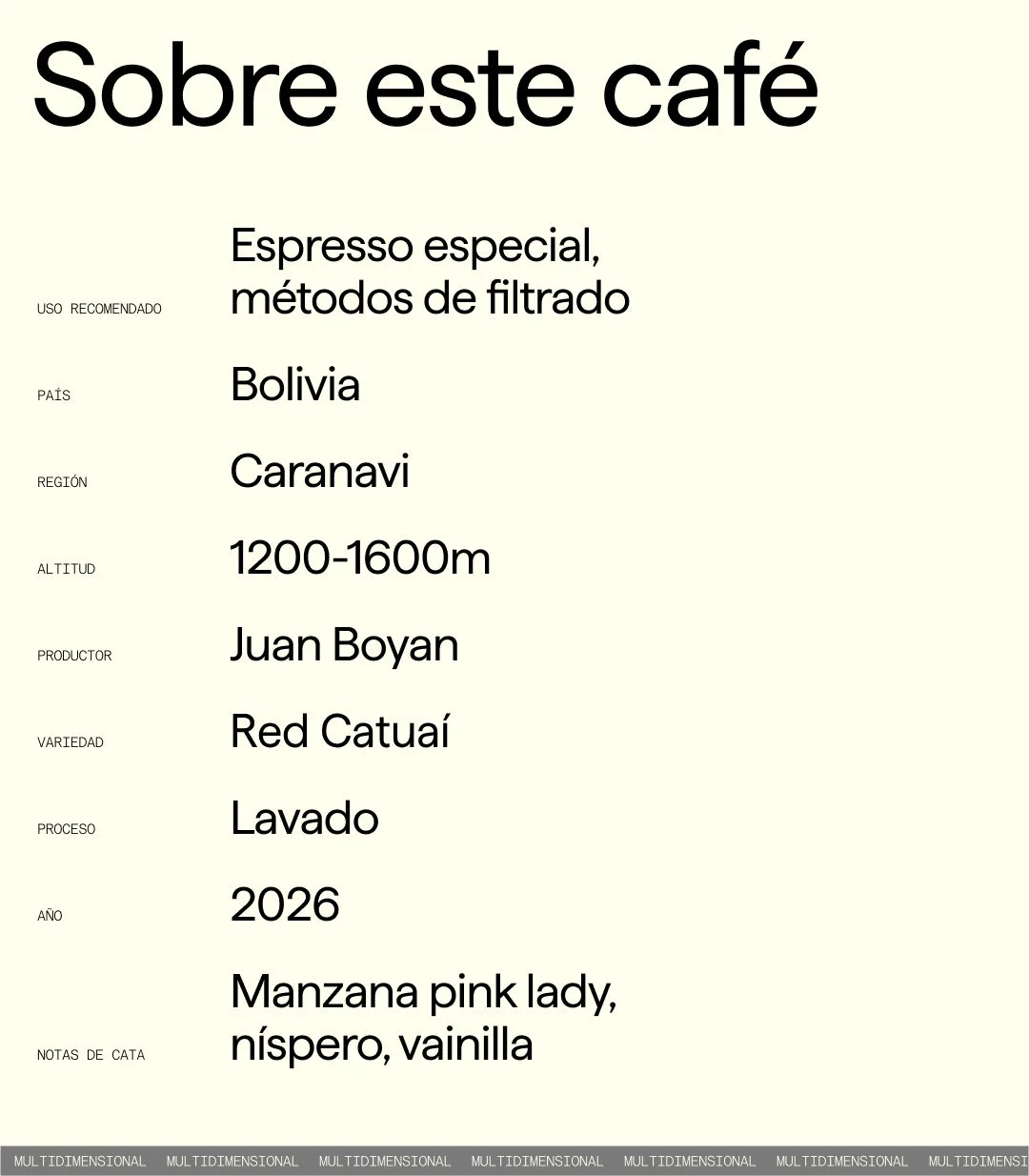
In the heart of Caranavi, one of Bolivia’s most important coffee-growing regions, ATOQ is born, a coffee that stands out not only for its cup profile, but also for the human story behind it. Grown at altitudes between 1,200 and 1,600 metres, this Red Catuai lot, processed using the washed method, delivers a clean and expressive cup, with notes of Pink Lady apple and loquat, supported by a sweet base of vanilla. It is particularly well suited to filter brewing, though it can also shine as a delicate, well-executed espresso.

But to truly understand ATOQ, you have to look beyond the cup. Bolivia is a complex origin, where political, cultural and social factors make it difficult to access producers directly. For years, much of the country’s coffee has been concentrated in the hands of a few players, leaving many smallholders in the shadows, largely invisible to the international market.

This is where Juan Boyan comes in.

Juan is a key figure in understanding modern Bolivian coffee. After more than two decades working at Agricafe, the country’s most well-known coffee company, he chose to forge his own path. His story begins humbly: at just 16, he started working in a factory carrying sacks of green coffee. His work ethic and attention to detail quickly set him apart, eventually leading him to become plant manager, overseeing roasting and machine maintenance.

A turning point came when he met Pedro Rodríguez, now president of Agricafe. Pedro asked him a question that would change his life: “Do you want to be a gatekeeper in a circus or a lion trainer?” Juan understood immediately, it was time to take on greater responsibility. This marked the beginning of a professional and personal relationship that would last over 20 years, shaped by challenges, learning, and deep mutual trust.

During this time, Juan managed more than a thousand microlots, developing an exceptional ability to assess quality, process coffee with precision, and organise lots for export. But over the years, he began to feel the need to build something of his own. His vision was clear: to bring visibility to Bolivia’s smallholder producers, many of whom remained unknown.

In 2019, he took the leap. He purchased machinery, left behind the security of Agricafe, and built his own dry mill in La Paz. The early days were far from easy. Loneliness, uncertainty, and physical effort defined his first years of independence. At one point, he even used the money he and his wife had saved for a car to complete the construction of his facilities. Still, with her support, he kept going.

Today, Juan’s project has become a meeting point for smallholders. Many of them, often in very difficult economic situations, bring their coffees to his mill. Juan not only provides processing and access to market, but also a real opportunity for their work to be recognised. In some cases, he even buys their coffee with his own money to support them.

ATOQ is a reflection of all of this. It is the result of a network built on trust, knowledge, and collective effort, a coffee that represents a new way of understanding Bolivia: more open, more accessible, and full of untapped potential.

In the cup, this translates into balance and clarity. A honeyed acidity carries the ripe fruit notes, while a silky body supports a refined, fruity finish. Beyond its sensory profile, ATOQ is an invitation to take a closer look at an origin that, thanks to people like Juan, is finally beginning to reveal itself to the world.

Recetas para este café

Filter

The recipe below is a guideline to follow at home. Results will always vary depending on your own equipment, setup and all the variables that can affect coffee extraction.

Every coffee we roast one of our team will experiment to come up with something we like to drink, below details all the information you need to recreate the recipe, however we always recommend tasting and experimenting to find out what you like, use the following as a guideline and adapt.

It’s the journey not the destination.

Some key things to note: Water is the most important precursor to having a tasty cup of coffee, depending on where you live water composition can vary wildly and for this reason we recommend using filtered water at a minimum, a mixture of Bezoya and Lanjarón water is a better option. When you change any part of the recipe, always change one thing at a time so you know the influence it had on flavour.

Normally we will start by adapting the ratio to our liking first and once we have a brew with a pleasant strength and mouthfeel we can look at the other aspects of the extraction to altar.

Most percolation coffee filter coffees thrive with a ratio between 1:15 and 1:17. Brewed between 2:30 and 4:30.

Kalita/Origami/Orea

We’ve chosen these methods to express our recipes as they are forgiving and easily transferable to other percolation recipes, the flat bottom and crimped sides of the Kalita papers give a large surface area that prevents any major stalling of the flow due to fines migration & clogging.

Kalita/Origami/Orea

Recipe:

  • Ratio: 1:17
  • Coffee: 20gr
  • Water: 340ml/gr
  • Total time: 3:20-4 min
  • Temperature: 94ºC
  • Grinder setting: 21 'clicks' Comandante
  • Measured TDS and extraction yield (EY) of the tested recipe

Variables:

  • Coffee resting time: minimum of 1-2 days peaks after 1-2 weeks
  • Water used: Bezoya 1:2 Lanjarón
  • Paper filter: Kalita 185

Equipment:

Kalita/Origami, Kalita filter, Scales, timer, grinder, mug or decanter, kettle preferably gooseneck.

Method:

  1. Heat the water in the kettle and when hot rinse the paper filter on the origami to remove any paper flavor and preheat the brewer.
  2. Grind the coffee to the recommended size.
  3. Throw away the used water and replace the brewer and distribute the ground coffee in a level bed in the filter, some like to poke a little divit in the top as to aid saturating all the coffee, tare the scales.
  4. Start the stopwatch as you start pouring 60g/ml of water slowly and gently in a circular motion and wait 30-40 seconds for the grounds to degas, being mindful to saturate the entire coffee bed. If the coffee was roasted recently you will notice the bed expanding and you may wish to leave to degas for longer.
  5. Pour the remaining water slowly until you reach 200-250ml/gr, ensure the water never comes above an inch from the top to avoid the water bypassing the coffee and reducing the extraction, pause to let it drain if it comes too high.
  6. Gently and carefully lift and swirl the brewer once to level the bed.
  7. Continue to slowly pour the remaining water and swirl the brewer once to give a good level drawdown.
  8. We are looking for the brew to finish in the time stipulated, adjust the grind size if necessary for the next time you brew.

Espresso

Here's our most up-to-date recipe. It's important to remember that this recipe is a reference and that many variables will influence the final result of the espresso in your cup: from the condition of your machine and grinder, the water you use, the storage/steeping time of your coffee, to the temperature/atmospheric pressure, etc. Therefore, you may need to adjust some parameters to achieve a flavorful and balanced espresso based on your specific needs.

Recipe:

  • Ratio: 1:2.2
  • Dry: 18gr
  • In cup: 41gr
  • Time: 30-36s

Variables:

  • Resting time: minimum 2 weeks
  • Temperature: 94ºC
  • Pressure: 6 bars
  • Pre-infusion: No
  • GH 60 (ppm as CaCO3) KH 30 (ppm as CaCO3)

Machinery and equipment used for this recipe:

  • Espresso machine: La Marzocco KB90 2G
  • Mill: Mythos 1
  • Scoop: 22gr VST (without slot)
  • Extras: Barista Hustle WDT, Push Tamper (flat, 100% level)

Cold brew

That's the recipe we suggest for making 600ml of cold brew. If you want to make more or less amount, the ratio is 1:15, 1g of coffee for 15g/ml of water.

Recipe and equipment:

  • 40g coffee (Use your preferred coffee depending on your taste. We suggest choosing coffee profiles you like in filter brewing). If it has the "Cold Brew" tag, it's one of our favorites.
  • Grinding: Comandante 16 clicks.
  • Water 600g/ml at room temperature.
  • Water composition: 2 parts Lanjarón and 1 part Bezoya.
  • A mesh or silk.
  • A glass container (preferably with a lid)
  • Let it rest for 22 hours (in the refrigerator).

How to make cold brew:

  • We grind the coffee to a medium ground size (Comandante 16 clicks).
  • We pour the coffee directly into the mesh.
  • We put the mesh into the glass container.
  • We pour the water into the container through the mesh with the coffee.
  • Stir gently to flood all the coffee.
  • We close or cover the container.
  • We leave it rest in the refrigerator (beware of strong smells!).
  • After the resting time, remove the mesh with the coffee and it will be ready.
  • As an extra step, you can filter it again through a V60, Kalita or similar paper filter for a cleaner and clearer result.
  • Keep it refrigerated.
  • This recipe is meant to be undiluted, not even with ice. Adding ice will affect the flavor of your drink, as the water composition will alter the flavor. It's best to make your own ice using the same water composition we suggest. If you do use ice, you might want to lower the ratio (1:9 to 1:12).

Related products

FREE SHIPPING

Spain (Peninsula)

>40€ / Delivery 24/48h LV

Balearics

>40€ / Delivery 3/5 days, LV

Portugal

>40€ / Delivery 3/5 days, LV

Europe

>99€ / Delivery 4/7 days, LV

See more...